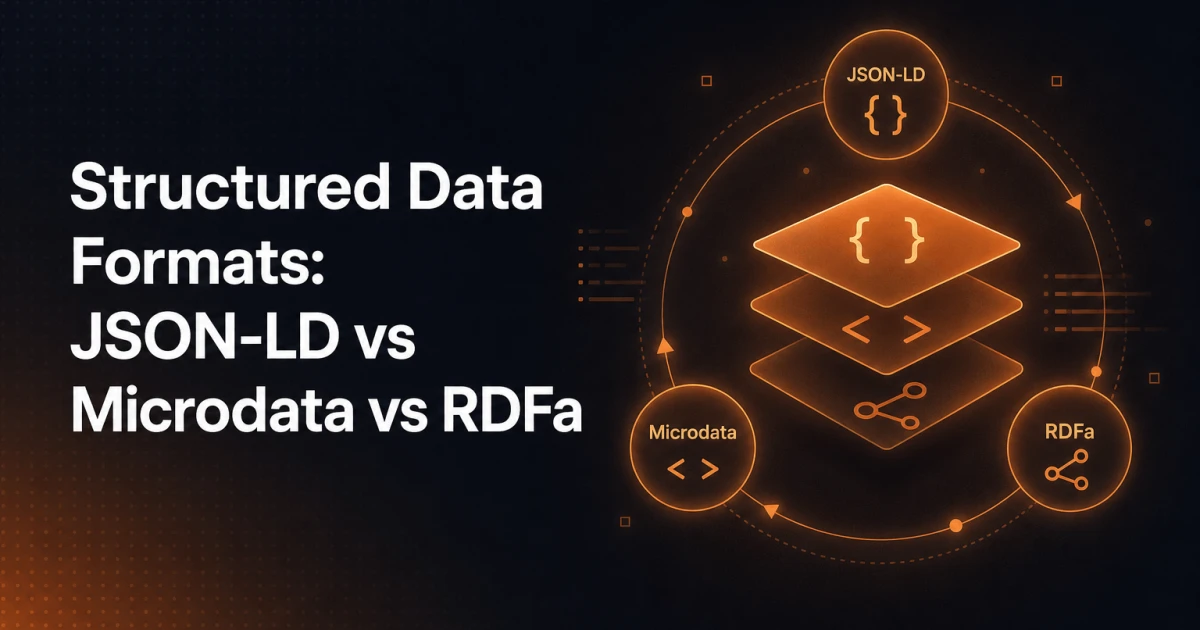
Structured data has exactly one job: communicate page meaning to machines in a language they can parse without guessing. The question of how to deliver that communication - JSON-LD, Microdata, or RDFa - is where many developers and SEO professionals spend far more time than necessary. The formats are not equivalent in practice, and the choice has real consequences for maintainability, error rates, and how reliably search engines extract the data you intend.
All three formats use the same underlying vocabularies - primarily Schema.org - to describe entities like articles, products, reviews, and organizations. The difference lies in how that vocabulary is embedded in a document. Understanding that distinction makes the right choice obvious.
JSON-LD: Structured Data as a Separate Concern
JSON-LD (JavaScript Object Notation for Linked Data) places schema markup inside a <script type="application/ld+json"> block. That block can live in the <head> or anywhere in the <body> - Google's crawlers parse it in either location. The markup is entirely separate from the visible HTML content of the page.
A minimal JSON-LD block for an article looks like this:
<script type="application/ld+json">
{
  "@context": "https://schema.org",
  "@type": "Article",
  "headline": "JSON-LD vs Microdata vs RDFa",
  "author": {
    "@type": "Person",
    "name": "Jane Smith"
  },
  "datePublished": "2025-01-15"
}
</script>
Google explicitly recommends JSON-LD for structured data implementation, and has done so consistently since 2015. The reasoning is straightforward: because the markup is decoupled from the HTML, it can be added, modified, or removed without touching the visual layer of the page. A template change that restructures a heading or moves a date element does not break the schema. A CMS update that reformats the DOM leaves the JSON-LD block untouched.
This separation also means JSON-LD can be injected dynamically - via a plugin, a server-side template, or even a tag manager - without requiring access to individual HTML elements. For WordPress specifically, this matters enormously: themes change, page builders restructure output, and plugins add or remove HTML wrappers. JSON-LD survives all of that intact.
The format also supports nested objects and arrays natively, making complex schema types like HowTo, FAQPage, or Product with AggregateRating straightforward to write and read. Debugging a JSON-LD block means reading a clean JSON object - not hunting through interspersed HTML attributes.
Microdata: Markup Woven Into the HTML
Microdata takes a fundamentally different approach: the schema vocabulary is embedded directly into HTML elements using attributes. The three core attributes are itemscope, itemtype, and itemprop.
<div itemscope itemtype="https://schema.org/Article">
  <h1 itemprop="headline">JSON-LD vs Microdata vs RDFa</h1>
  <span itemprop="author">Jane Smith</span>
  <time itemprop="datePublished" datetime="2025-01-15">January 15, 2025</time>
</div>
Microdata was introduced alongside HTML5 and gained traction when Google, Bing, and Yahoo jointly launched Schema.org in 2011. At the time, it was a reasonable choice - it kept markup and content co-located, which appealed to developers who wanted a single source of truth for both human readers and crawlers.
The maintenance burden, however, is significant. Every structural change to the HTML risks breaking the schema. A developer who wraps the author name in an additional <span> for styling purposes, or who moves the date into a different container, can inadvertently break the itemprop chain. In a CMS environment where multiple people edit templates and content, this is not a theoretical risk - it is a routine one.
Microdata is still fully supported by Google and remains valid. For hand-coded static pages with stable HTML structures, it works without issue. For dynamic CMS environments, it introduces fragility that is difficult to justify.
RDFa: Flexible, Verbose, and Vocabulary-Agnostic
RDFa (Resource Description Framework in Attributes) is the most technically capable of the three formats. Like Microdata, it embeds markup directly in HTML using attributes - but it can express relationships from multiple vocabularies simultaneously, and it supports the full expressiveness of the RDF data model.
<div vocab="https://schema.org/" typeof="Article">
  <h1 property="headline">JSON-LD vs Microdata vs RDFa</h1>
  <span property="author">Jane Smith</span>
</div>
RDFa originated in the academic and publishing world, where linking data across multiple ontologies - Schema.org, Dublin Core, FOAF, and others - is a genuine requirement. It remains common in government data portals, academic repositories, and large-scale publishing platforms where interoperability between data systems matters.
For SEO purposes, RDFa's multi-vocabulary capability is rarely needed. Google's structured data processing focuses on Schema.org, and the additional complexity RDFa introduces - verbose attribute syntax, namespace declarations, a steeper learning curve - provides no practical benefit in a standard web publishing context. The W3C maintains RDFa as a formal standard, and it is not going away, but its use case in commercial SEO is narrow.
Side-by-Side Comparison
| Criterion | JSON-LD | Microdata | RDFa |
|---|---|---|---|
| Placement | Separate <script> block | Inline HTML attributes | Inline HTML attributes |
| Google support | Recommended | Supported | Supported |
| Developer experience | Clean, readable JSON | Verbose, scattered across DOM | Very verbose, namespace-heavy |
| Maintenance burden | Low - decoupled from HTML | High - tied to DOM structure | High - tied to DOM structure |
| CMS compatibility | Excellent | Fragile | Fragile |
| Multiple vocabularies | Possible but uncommon | Limited | Native support |
| Dynamic injection | Straightforward | Requires DOM access | Requires DOM access |
| Primary use case | All web contexts | Static HTML pages | Publishing, linked data systems |
The Clear Recommendation: JSON-LD for WordPress
For WordPress - and for the vast majority of web projects - JSON-LD is the correct choice, and not by a narrow margin. The reasoning rests on three concrete realities.
WordPress is a dynamic environment. Themes update. Page builders restructure markup. Plugins add wrapper elements. Child themes override templates. In this context, any structured data format that depends on a specific DOM structure will break silently and unpredictably. JSON-LD lives outside that chaos. It is output by PHP functions or plugin logic and delivered as a standalone block, independent of how the rest of the page is assembled.
Google recommends it explicitly. This is not a minor preference - it reflects Google's own engineering experience parsing structured data at scale. When the format that is easiest for developers to maintain is also the one the most important crawler recommends, there is no meaningful argument for the alternatives in a standard SEO context.
Debugging and validation are faster. A JSON-LD block is a discrete, copyable object. Paste it into Google's Rich Results Test or the Schema Markup Validator and the result is immediate. With Microdata or RDFa, you must extract the parsed data from the full page render - a less direct workflow that adds friction to every iteration. You can also use the free Schema.org Generator to build valid JSON-LD for common schema types without writing it from scratch.
The one scenario where Microdata or RDFa might be justified is a legacy system where structured data is already deeply embedded in HTML templates and a migration would be costly with no clear SEO gain. In that case, maintaining the existing implementation is reasonable - but any new implementation should use JSON-LD.
How to Validate Structured Data in All Three Formats
Regardless of which format is in use, validation follows the same process. The primary tools are:
Google's Rich Results Test - Tests a URL or code snippet and shows which rich result types the page is eligible for. This is the most directly actionable tool for SEO purposes, since it reflects what Google's parser actually extracts.
Schema Markup Validator (validator.schema.org) - The official Schema.org validator, maintained independently of Google. It is more permissive and catches schema-level errors rather than rich-result eligibility specifically.
Google Search Console - Enhancements reports - Shows structured data errors and warnings across the entire site over time. Invaluable for catching regressions after theme or plugin updates.
For JSON-LD specifically, a syntax check with any JSON linter catches malformed markup before it ever reaches a validator. This is a step that Microdata and RDFa cannot offer - their markup is validated as part of the full HTML parse, not independently. The JSON Formatter tool can quickly surface syntax errors in a JSON-LD block before submission to a schema validator.
When running a full technical audit, structured data errors will surface alongside other on-page issues. The SEO Analyzer covers schema as part of its audit scope, giving a consolidated view of structured data health alongside performance, links, and mobile signals - which is more practical than running schema validation in isolation.
For WordPress sites where structured data is managed through a plugin, the Signocore SEO plugin generates JSON-LD output automatically, with schema types matched to the WordPress post type and template context rather than applying a generic site-wide block. This distinction matters: a BlogPosting schema on an archive page, or a WebPage schema on a product page, is noise at best and a miscommunication at worst. Page-specific schema generation is where automated implementations either earn their place or fail.
Schema Vocabulary Is the Same - the Container Is Not
A common source of confusion is treating the format choice as equivalent to the vocabulary choice. Schema.org defines what properties and types exist - Article, Product, author, price. JSON-LD, Microdata, and RDFa are just different containers for expressing those same properties. Switching from Microdata to JSON-LD does not change which schema types you use; it changes how they are delivered to the parser.
This also means that the broader role structured data plays in modern SEO - enabling rich results, supporting entity understanding, feeding knowledge graph signals - is independent of format. The format is an implementation detail. A well-structured JSON-LD block describing an FAQPage delivers exactly the same semantic value as equivalent RDFa markup. The difference is in how reliably that block gets written, maintained, and validated over the lifetime of a site.
Pick JSON-LD. Write clean, page-specific schema. Validate before publishing. That sequence, applied consistently, is what moves structured data from a technical checkbox into a genuine signal that search engines act on.