Zero-click searches were already a problem before AI Overviews arrived. Featured snippets, knowledge panels, and answer boxes had been eating into organic click-through rates for years. So when Google began rolling out AI Overviews at scale in 2024, the "SEO is dead" crowd found fresh ammunition. The panic was understandable - but the full picture is more complicated, and more actionable, than the headlines suggest.
The sites losing the most traffic right now are not the ones being punished by AI. They are the ones that built their entire strategy on answering generic informational queries that AI can now resolve in a single paragraph. That is a real problem - but it is a strategy problem, not an SEO apocalypse.
What AI Overviews Are and How They Rolled Out
Google's AI Overviews - previously known as Search Generative Experience (SGE) during its experimental phase - generate synthesized, AI-written summaries at the top of search results pages for qualifying queries. They pull from multiple indexed sources, cite them with small source chips, and deliver an answer before the user ever reaches a traditional blue link.
After a limited US rollout in May 2023 and a broader US launch in May 2024, AI Overviews began expanding internationally through late 2024 and into 2025, reaching over 100 countries. The rollout was not without turbulence - early versions surfaced factually incorrect answers and drew significant press criticism, prompting Google to refine triggering logic and reduce the frequency of AI Overviews on sensitive or ambiguous queries.
By mid-2025, AI Overviews appear on an estimated 15-20% of all Google searches in markets where they are fully deployed. That number is not uniform across query types - which is precisely where the CTR story gets interesting.
The CTR Data: What Research Has Found
Multiple independent studies have attempted to quantify the CTR impact of AI Overviews, and their findings are broadly consistent even when their methodologies differ.
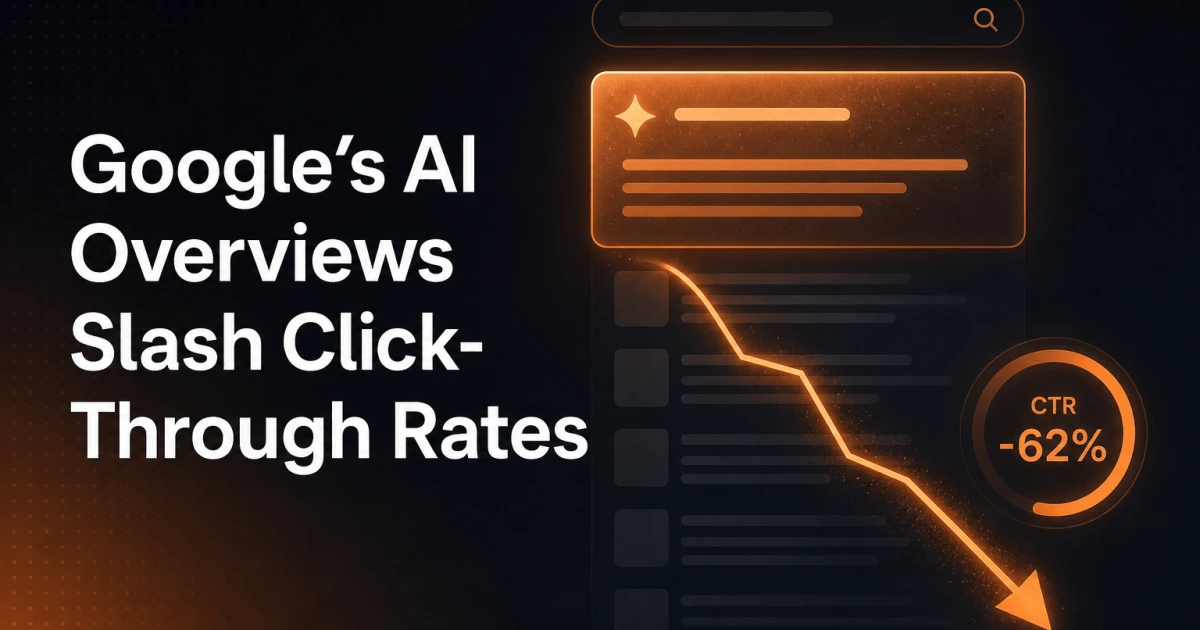
Research from Authoritas and BrightEdge found that queries triggering AI Overviews see organic CTR drops in the range of 25-64% compared to the same queries without an AI Overview present. A Semrush analysis of millions of keywords found that informational queries with AI Overviews had significantly lower average CTRs than equivalent queries without them. Advanced Web Ranking's CTR curve data, updated post-rollout, shows the position 1 CTR for AI Overview queries is substantially compressed - clicks that used to go to the top organic result are either absorbed by the AI summary or lost entirely as users get their answer and leave.
None of this is surprising. When Google answers the question at the top of the page, fewer people scroll down. The mechanism is straightforward. What matters is understanding which questions Google is answering - and which it is not.
Which Queries Are Hit Hard, Which Are Not
The impact is not evenly distributed, and this is the part most of the doom-and-gloom coverage glosses over.
Informational queries: the hardest hit
Queries like "how does X work," "what is Y," "symptoms of Z," or "best way to do W" are prime territory for AI Overviews. These are the queries where a synthesized paragraph genuinely satisfies user intent. If your site's traffic is heavily weighted toward this type of content - think health information hubs, general how-to guides, or broad educational explainers - the CTR data is not good news. Organic visibility may remain while actual clicks collapse.
Navigational queries: largely unaffected
When a user searches for a specific brand, product, or website, AI Overviews rarely trigger. Google understands that navigational intent means the user wants a specific destination, not a synthesized answer. Branded search traffic remains among the most defensible organic channels available, and that defensibility has only increased since AI Overviews launched.
Transactional queries: mixed but still strong
Queries with clear commercial intent - "buy X," "X pricing," "X vs Y comparison," "best X for Y use case" - trigger AI Overviews less frequently than informational queries, and when they do appear, the source chips are more prominent because Google knows users are closer to a decision and need to evaluate real options. CTR impact exists but is substantially smaller. Sites with strong transactional content are holding their traffic better than pure informational publishers.
Local and hyper-specific queries: mostly safe
Local searches, niche technical queries, and highly specific long-tail questions are poor candidates for AI Overviews. Google's AI struggles to synthesize authoritative answers for questions that require local knowledge, real-time data, or deep domain specificity. These query types continue to drive meaningful organic clicks.
What This Means for Content Strategy
The sites adapting fastest share a common reframe: they have stopped treating content as a vehicle for ranking and started treating it as a vehicle for demonstrating irreplaceable expertise. These are not the same thing.
Original data and proprietary research
AI cannot synthesize what does not exist on the web. Original survey data, internal benchmark reports, case studies with real numbers, and first-party research are among the most AI-resistant content types available. A post that says "based on our analysis of 500 client campaigns, here is what we found" cannot be replaced by a summary of publicly available information - because it is not publicly available information until you publish it. This is not a new content strategy principle, but AI Overviews have made it urgent rather than optional.
Branded search as a moat
Building a brand that people search for by name is the cleanest hedge against AI Overview cannibalization. If users search "Signocore SEO analyzer" or "[your brand] pricing," no AI Overview is going to intercept that traffic. Brand-building through consistent publishing, community presence, and distinct positioning protects the navigational traffic that AI surfaces cannot touch.
Transactional content depth
Comparison pages, detailed pricing breakdowns, feature-by-feature analyses, and buyer's guides with genuine editorial judgment are performing better than general informational content in the AI Overview era. These formats serve users who are close to a decision - and Google knows those users need real destinations, not AI summaries. Investing in this layer of the content funnel is not just commercially sensible, it is structurally more defensible against AI cannibalization.
Structured data and schema markup
One underappreciated angle: sites cited within AI Overviews receive source chip attribution, and there is growing evidence that structured, well-marked-up content is more likely to be cited. Proper structured data implementation does not guarantee citation, but it makes your content more machine-readable and more useful to the AI synthesis process. Being cited in an AI Overview is not as valuable as a direct click, but it is meaningfully better than invisibility - and it does drive some traffic from users who want to verify or explore further.
If you want to audit how well your current pages are structured for both traditional and AI-driven discovery, the SEO Analyzer covers schema coverage, on-page signals, and technical health in a single pass - useful for identifying gaps before they compound.
AEO and GEO: The Strategic Adaptations Taking Shape
Two frameworks have emerged in response to AI-driven search surfaces: Answer Engine Optimization (AEO) and Generative Engine Optimization (GEO). Both are worth understanding, though neither is a silver bullet.
AEO focuses on structuring content so that AI systems - including AI Overviews, ChatGPT, Perplexity, and others - can extract and surface accurate answers with proper attribution. It emphasizes clarity of structure, explicit answer formatting, and authoritative sourcing. GEO goes further, optimizing for how AI generative systems characterize and represent your brand or content across conversational queries - not just whether you rank, but whether the AI describes you accurately and favorably.
The GSEO and AI Overview optimization space is evolving fast, and a fuller treatment of GEO as a discipline is worth its own deep dive - the strategic arc of GEO covers how this fits into SEO's longer evolution. The short version: both AEO and GEO reward the same underlying qualities that traditional SEO always rewarded at its best - depth, authority, clarity, and genuine usefulness. The difference is that AI surfaces make those qualities non-negotiable rather than merely advantageous.
The Honest Assessment
The zero-click narrative is not wrong - it is incomplete. AI Overviews are compressing CTRs on informational queries in a real and measurable way. Publishers who built traffic on answering generic questions at scale are facing structural decline that no amount of on-page optimization will reverse. That part of the sky is falling, and pretending otherwise is a disservice.
But transactional content, branded search, original research, and deep expertise content are not experiencing the same collapse. The sites that are adapting are not doing so by gaming AI systems - they are doing so by producing content that AI cannot replace because it is genuinely irreplaceable: specific, opinionated, data-backed, and tied to a recognizable source that users want to visit directly.
The game has changed, but there is still a game. The teams winning it are the ones who stopped treating content volume as a strategy and started treating content quality - real quality, not the SEO-checklist version - as the only defensible position left. That shift was overdue long before AI Overviews arrived. Google's AI just made the cost of ignoring it impossible to defer.