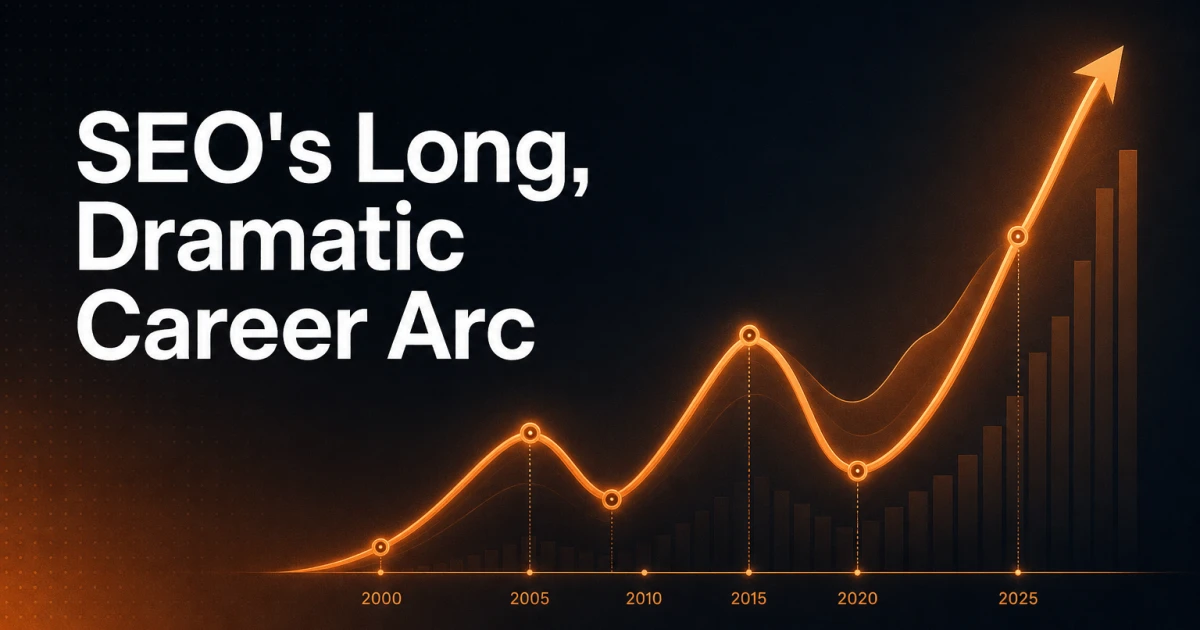
For twenty years the SEO industry has had one single goal: to make Google happy. We have analyzed algorithms, cultivated backlinks as if they were rare orchids, and debated keyword density with an intensity that would make a theologian feel unserious. Then ChatGPT showed up to the party in an outfit no one expected, and suddenly Google is no longer the only one deciding who gets seen.
Welcome to the era of Generative Engine Optimization. Or GEO, because the industry loves a good acronym almost as much as it loves declaring that "SEO is dead" every three years.
What GEO actually means (and why someone should worry)
GEO is about optimizing your content so it doesn't just appear in search results, but is cited by AI systems when they generate answers. When someone asks ChatGPT for the best project management tools, or when Perplexity synthesizes an answer about investment strategies, these systems pull from sources on the web. GEO is the art of becoming the source the AI chooses to cite.
Researchers from Princeton University and Georgia Tech introduced the concept in an academic paper in November 2023. Their studies showed that specific optimization techniques can increase visibility in AI-generated answers by up to 40%. That's not a trivial improvement.
Here is the central difference: Traditional SEO focuses on ranking high on a list of ten blue links. GEO focuses on being mentioned when there is no list at all. AI systems like ChatGPT, Claude, Gemini and Perplexity generate a single, synthesized answer instead of presenting a range of options. If your content isn't cited in that answer, you don't exist in that context.
The panic isn't entirely unfounded. AI platforms already drive around 6-7% of organic traffic to websites, and that share is expected to reach 14-15% within the next year. It may sound modest, but the trend is accelerating. Younger users, particularly millennials and Generation Z, increasingly skip traditional search engines and go directly to AI tools for answers.
How AI engines decide who deserves a mention
To understand how AI systems choose sources, you need insight into something called Retrieval-Augmented Generation. RAG systems pull relevant information from online sources and use it as the basis for the answers they generate. It's not magic. It's advanced text matching combined with assessment of source credibility.
AI systems prioritize sources based on a few specific factors.
Authority and credibility weigh heavily. Content from established institutions, recognized experts, and domains with high E-E-A-T (Experience, Expertise, Authoritativeness, Trustworthiness) have an edge. If your website has never been cited as a source by other credible publications, you start with a handicap.
Structure and clarity play a crucial role. AI models can't browse in the same way humans do. They extract information. If your content isn't structured in a way that makes it easy to pull meaningful passages, it will be overlooked in favor of competitors who've made it easier for the machine to extract.
Factual density is surprisingly important. Princeton research showed that adding statistics, quotes from experts, and references to credible sources significantly increased visibility. AI systems look for content that can back up the claims they generate. Vague statements without data are hard to cite.
Freshness is also a factor. Content from the most recent two to three months dominates AI citations for many topics. If your "ultimate guide" was last updated in 2022, you're competing with articles containing 2025 data, and the AI almost always chooses the newer one.
What's interesting is that these factors aren't completely foreign to people who have worked with SEO for years. The difference lies in how they are weighted and applied. Keyword density, once the SEO industry's religious doctrine, has almost no significance for AI systems that understand semantics and context. Backlinks, the holy grail of traditional SEO, still influence your overall authority, but AI systems don't look directly at your backlink profile when selecting sources for a specific answer.
Practical tactics that don't require sacrificing your soul
The good news is that effective GEO doesn't require you to throw everything you know about content marketing in the trash. It requires adjusting focus and adopting a few new habits.
Start by structuring your content for extraction. That means short, factual blocks of 60-100 words per paragraph. It means direct answers to questions within the first 40-60 words of relevant sections. It means headings that clearly signal what the section is about, rather than cryptic phrasing that only makes sense if you read the entire text.
Systematically add data, statistics, and quotes. Princeton research showed that "Cite Sources", "Quotation Addition" and "Statistics Addition" were the methods that consistently delivered the best results across domains. Aim for a new statistic or reference roughly every 150-200 words. It's not about cramming numbers everywhere, but about backing up your points with verifiable information.
Implement schema markup thoroughly. FAQ schema, How-To schema, Product schema, and Author schema help AI systems understand the context of your content. It's not new for SEO veterans, but the priority is higher now. Structured data acts as a clean data layer that the AI can evaluate directly.
Think about where your brand is mentioned beyond your own website. AI systems pull from many sources, and if your brand is consistently mentioned in credible list articles, industry publications, and forums like Reddit, it increases the likelihood that you'll be included in generated answers. Some analyses suggest that up to 87% of SearchGPT citations match top results from Bing, meaning that cross-platform visibility remains important.
Keep your content up to date with visible dates. Add "Last updated: November 2025" and timestamp it. Update statistics, add new cases, remove outdated references. AI systems favor fresh content, and a visible update date signals that the information is current.
Avoid JavaScript-heavy pages where possible. Many AI crawlers still have trouble reading content that is rendered via JavaScript. Server-side rendering is preferred. If your content is invisible to crawlers, it's also invisible to AI answers.
What actually dies versus what merely gets a makeover
Let's be honest about what fundamentally changes and what only gets adjusted.
Keyword density as a concept is basically dead for GEO purposes. AI systems understand semantics. They know that "project management tool" and "software to manage projects" mean the same thing. Repeating your target keyword 47 times in an article does not improve your chances of being cited. It makes the content worse.
Positioning, the intense focus on being number one on page one, is losing its absolute dominance. When AI-generated answers replace lists of links for many queries, the question isn't "which position do I have," but "will I be mentioned at all." That doesn't mean rankings are useless. About 50% of sources cited in AI Overviews also rank in the Google top 10. But the relationship isn't as direct as it used to be.
Link schemes, the dubious methods of accumulating backlinks through link exchanges, PBN networks, or "link insertions," lose their effectiveness. AI systems evaluate authority in other ways, and Google itself has tightened its grip significantly. It doesn't mean links are irrelevant, but the sources for links and context matter more than sheer quantity.
Conversely, high-quality content is more relevant than ever. Ironically, because if "content is king" has become a hollow cliché, it's now actually more true than it has been for years. AI systems seek content they can cite with confidence. Thin content without substance is ignored.
Technical SEO doesn't get a makeover. It remains critical. Crawlability, indexability, speed, mobile-friendliness, HTTPS, structured data. All of it is just as important for GEO as it always has been for SEO. In fact, it's perhaps more important, because AI crawlers can be less forgiving than Googlebot.
E-E-A-T moves from important to essential. Experience, Expertise, Authoritativeness, Trustworthiness were already central to Google. For AI systems that must choose one source to cite from thousands, these signals are often the tipping point.
Wild but plausible predictions for the circus's future
Here comes the part where I risk looking stupid in two years. But based on the trends emerging, some trajectories are more likely than others.
AI citation share becomes a standard KPI in marketing departments by the end of 2026. Just as we today track organic traffic, rankings, and CTR, we will track how often our brand is cited in AI-generated answers. Tools for this purpose are already popping up with names like Profound, Otterly AI, Scrunch AI and the like.
Zero-click searches accelerate dramatically. Some reports indicate that 47-60% of certain query types already result in zero clicks, because the user gets their answer directly. With AI Overviews rolled out to over a billion users monthly, that share will rise. This means conversion optimization becomes more important than traffic volume for many businesses.
Brand visibility fragments further. Search is no longer a single place. It's Google, Bing, ChatGPT, Perplexity, Gemini, TikTok, YouTube, Amazon, Reddit. Winners will be the companies that manage to be consistently visible across platforms, not just those that dominate one channel.
AI-specific file formats gain traction. There are already experiments with formats like llms.txt, designed to make web content more interpretable for generative engines. It sounds nerdy, but it's the same type of development we saw with XML sitemaps and robots.txt fifteen years ago.
Personalization of AI answers creates new challenges. When AI systems tailor answers based on the user's context, preferences, and history, it becomes harder to know what "visibility" even means. Your content could be cited for one user and ignored for another based on factors you don't control.
The provocative prediction: By 2027, "SEO specialist" as a job title will be as dated as "webmaster." Not because the discipline disappears, but because it's absorbed into broader roles that cover visibility across all digital touchpoints. Those who insist on focusing only on Google rankings will find their relevance fading.
The important takeaway here
GEO is not a replacement for SEO. It's an expansion. The fundamental principles of creating valuable content that answers users' questions remain unchanged. What changes is who evaluates your content and how they present it to users.
Companies acting now are building citation shares while competition remains relatively low. Companies that wait will discover that first-mover advantage is real, and that it's harder to catch up to those already established as credible sources in AI systems' eyes.
The panic is overvalued. The adaptation is undervalued. Google still handles more than 5 trillion searches annually with 20% annual growth. Traditional search isn't disappearing. But AI search is growing faster from a lower base, and the users who adopt it early are often those with the greatest purchasing power and influence.
The smart move is neither to ignore GEO nor to drop everything else to focus exclusively on it. It's to integrate GEO principles into your existing content strategy, measure results, and adjust continuously. Just as we've always done with SEO, only with more acronyms and an audience that now includes machines that actually talk back.