The pitch sounds compelling: run your code at 200+ locations around the globe, milliseconds from any user, no server to manage. Edge functions and serverless computing have become the infrastructure conversation of the last few years - and if you work with WordPress, you've probably wondered whether you're missing out. The honest answer is more nuanced than the hype suggests, and understanding exactly why reveals something important about how WordPress actually works under the hood.
What Edge Functions Actually Are
A traditional web request travels from the user's browser to your origin server - wherever that physically sits. For a WordPress site, that might be a VPS in Frankfurt, a managed hosting cluster in Virginia, or a shared server somewhere in between. The further the user is from that origin, the more latency accumulates before a single byte is returned.
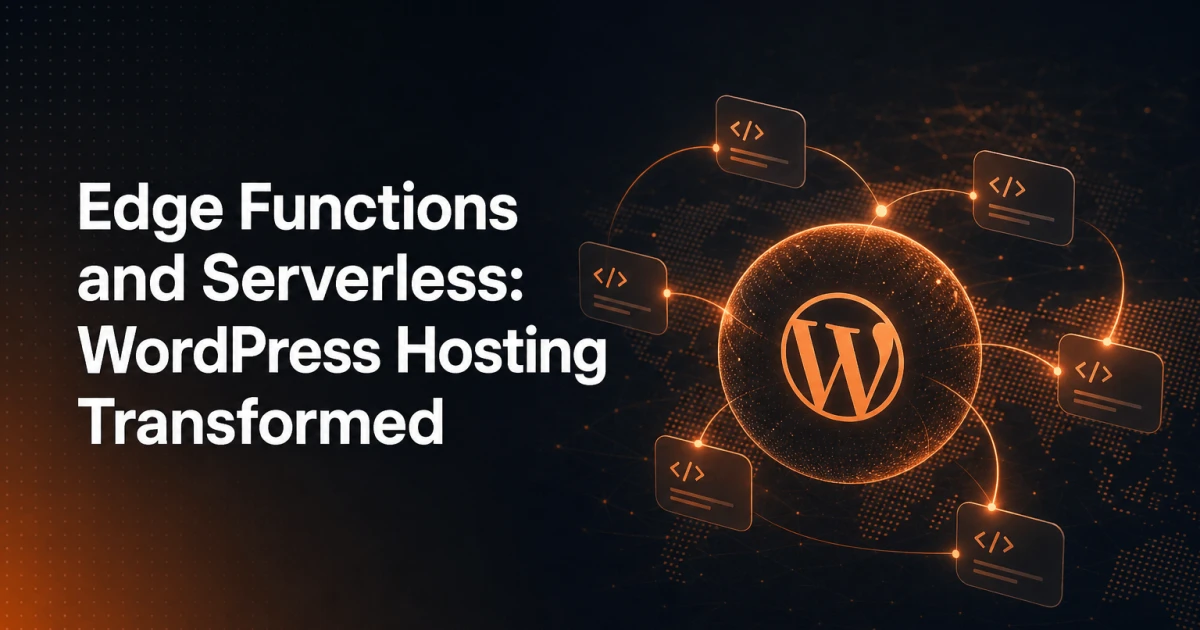
Edge functions flip this model. Instead of executing code at one origin, you deploy lightweight JavaScript (or WebAssembly) to a CDN's global network of edge nodes. When a request arrives, the nearest node intercepts it and executes your function - often within 5-10ms of the user, regardless of where your origin server lives. The function can then decide to serve a cached response, modify headers, redirect the request, or forward it to the origin with enriched context.
Platforms doing this at scale include:
Cloudflare Workers - runs V8 isolates at Cloudflare's 300+ edge locations, with access to KV storage, Durable Objects, and R2. Pricing starts free with generous limits, making it accessible for experimentation.
Vercel Edge Functions - tightly integrated with Next.js and the Vercel deployment pipeline, using the same V8-based runtime. Particularly well-suited for headless frontends consuming WordPress as a content API.
AWS Lambda@Edge - runs Node.js functions at CloudFront edge locations, triggered by viewer or origin request/response events. More configuration overhead than the others but deeply integrated with the AWS ecosystem.
Serverless Is Not the Same Thing
These two terms get conflated constantly, and conflating them leads to bad architectural decisions. Serverless - in the Function-as-a-Service sense - means you write discrete functions that execute on demand, with no persistent server process. AWS Lambda, Google Cloud Functions, and Azure Functions are the canonical examples. You pay per invocation, you don't manage infrastructure, and your function can run anywhere in a provider's region.
Edge functions are a subset of serverless, but with a specific constraint: they run at CDN edge nodes, which means they must be extremely lightweight. Most edge runtimes impose strict limits - Cloudflare Workers caps CPU time at 10ms on the free tier, and memory is measured in megabytes. You cannot run a full Node.js application there. You certainly cannot run PHP there.
This distinction matters enormously for WordPress developers, and we'll come back to it.
What Edge Functions Enable for WordPress
Even if your WordPress PHP application can't move to the edge, edge functions can still meaningfully improve a WordPress site's architecture. The key insight is that edge functions operate on the request and response layer - they intercept, modify, route, and serve, without needing to understand your application logic.
Smarter Caching Logic
Standard CDN caching is blunt: cache this URL for this long, bypass cache for logged-in users. Edge functions let you write custom cache logic. You can strip irrelevant query parameters before the cache key is computed, serve stale content while revalidating in the background, or implement cache segmentation by device type - all without touching your origin. For a high-traffic WordPress news site, this alone can reduce origin load by 60-80%.
A/B Testing Without Origin Roundtrips
Traditional A/B testing plugins in WordPress work by loading the page from the origin and then swapping content client-side, or by making the origin itself serve variant content. Both approaches add latency or complexity. An edge function can read a cookie, assign a variant, and route the request to the appropriate cached version - the user gets their variant at edge speed, and your origin serves two clean URLs instead of one messy conditional.
Geolocation-Based Routing
Edge runtimes expose geolocation data on every request - country, region, city. An edge function can redirect users to localized subdomains, inject locale headers before the request reaches WordPress, or serve entirely different cached pages to different regions. This is relevant if you're managing a multisite network with region-specific content, or if you need to comply with content regulations that vary by jurisdiction. The hreflang implementation for international SEO becomes cleaner when routing decisions happen before the origin is ever involved.
Auth Middleware
Protecting WordPress admin routes, REST API endpoints, or member-only content typically requires hitting the origin to validate a session. An edge function can validate a JWT or check a signed cookie at the edge, blocking unauthorized requests before they consume origin resources. This is particularly useful for headless WordPress setups where the REST API or WPGraphQL endpoint is publicly exposed.
The Hard Limit: PHP Doesn't Run at the Edge
Here's where the hype meets reality. WordPress is a PHP application. PHP requires a server runtime - Apache or Nginx with PHP-FPM, or a similar stack. No major edge platform supports PHP execution. Cloudflare Workers runs V8 isolates. Lambda@Edge runs Node.js or Python. The edge is a JavaScript (and increasingly WebAssembly) environment.
This means your WordPress application - the database queries, the plugin execution, the template rendering - will always run at an origin server. Edge functions can optimize what happens around that origin, but they cannot replace it. A dynamic WordPress page request that bypasses cache will always make the full origin roundtrip.
This isn't a criticism of WordPress - it's simply an architectural reality. The same applies to any server-rendered PHP application. The misconceptions about PHP and WordPress often include the assumption that PHP is a bottleneck that modern infrastructure should route around. In practice, well-optimized PHP with proper caching handles enormous traffic loads without edge functions entering the picture.
The Cache-Hit Reality
For most WordPress sites, the realistic scenario is this: a CDN sits in front of the origin and caches full-page HTML. A user requesting a cached page gets it from the nearest edge node with or without edge functions - standard CDN behavior already handles this. Edge functions add value only when you need logic at the edge, not just caching. If your site serves mostly static or lightly dynamic content with good cache hit rates, the marginal gain from edge functions is minimal.
The Headless Bridge - Where Edge Functions Genuinely Shine
The architectural pattern where edge functions deliver the most value for WordPress is headless - where WordPress serves as a content API and a JavaScript frontend (Next.js, Nuxt, Astro) handles rendering. In this setup:
The frontend deploys to edge-native platforms like Vercel or Netlify, where pages are statically generated or server-rendered at edge nodes close to users.
Edge functions handle routing, personalization, and auth at the CDN layer, without touching the WordPress origin for every request.
WordPress becomes a backend-only concern - its PHP execution happens during content fetches and build processes, not on every user request.
This is the Jamstack model applied to WordPress, and it legitimately solves the "PHP can't run at the edge" problem by removing PHP from the critical path for most requests. The tradeoff is architectural complexity: you're now maintaining a decoupled frontend, managing content preview workflows, and handling real-time content updates across a build pipeline. That complexity is worth it for some sites and genuinely not worth it for others.
Performance engineering at this level also intersects with Core Web Vitals - headless WordPress with edge rendering can achieve LCP times that are structurally difficult to match with a traditional WordPress stack, particularly for global audiences.
When This Actually Matters for Your Site
Cut through the architecture enthusiasm and the answer comes down to a few concrete criteria:
High traffic with global distribution - If your site serves millions of pageviews monthly to audiences across multiple continents, edge optimization has measurable impact. For a regional business site doing 50,000 visits per month, it almost certainly doesn't justify the complexity.
Cache hit rates above 80% - Edge functions amplify the value of high cache hit rates. If most of your content is dynamic and user-specific (e-commerce, membership sites, real-time dashboards), edge functions solve a narrower problem - mostly around auth and routing - while the bulk of your requests still need origin processing.
Serious latency requirements - SaaS products, media companies, and applications where a 200ms difference in TTFB affects conversion rates have clear ROI from edge architecture. Content sites with standard SEO and UX goals generally don't.
Headless is already in your roadmap - If you're building a decoupled WordPress architecture, edge functions are a natural and valuable part of the stack. If you're running a traditional WordPress theme, adding edge functions is adding a layer of infrastructure complexity to solve a problem you may not have.
The SEO implications of CDN-based edge optimization are also worth understanding separately - edge logic can affect crawlability, redirect handling, and how search engines see your site, which introduces its own set of considerations before deploying edge functions in production.
The Practical Starting Point
Before reaching for Cloudflare Workers or Lambda@Edge, the right sequence for most WordPress sites is: optimize PHP execution, implement full-page caching at the origin or with a plugin, configure a CDN with sensible cache rules, and measure. For technical SEO and performance, tools like the SEO Analyzer can surface the concrete issues - slow TTFB, render-blocking resources, missing cache headers - that should be addressed before infrastructure complexity enters the conversation.
Edge functions are not a shortcut around the fundamentals. They're an additional layer that multiplies the value of a well-optimized origin - not a substitute for one.
The sites that benefit most from edge computing have already done the foundational work and hit the ceiling of what origin-side optimization can deliver. For most WordPress projects, that ceiling is much higher than assumed - and the edge is a future consideration, not an immediate one.