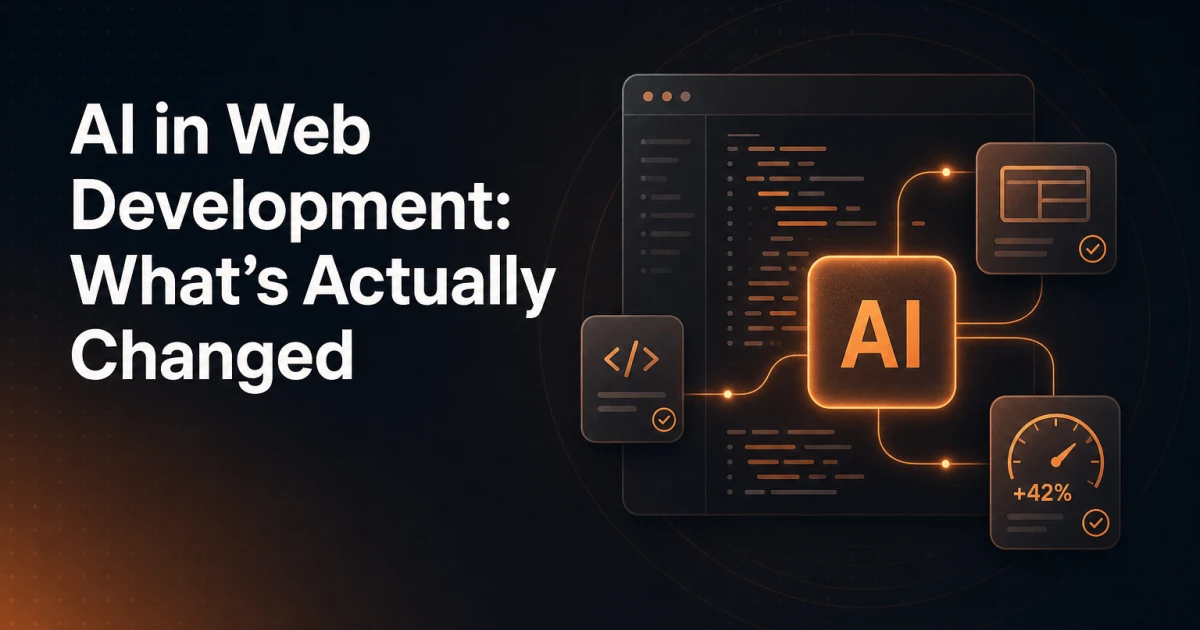
Most takes on AI and development land in one of two camps: breathless enthusiasm from people who've never shipped production code, or defensive dismissal from developers who've watched too many hype cycles burn out. Neither position is useful. The honest assessment sits somewhere more uncomfortable - AI has genuinely changed parts of web development, while leaving the hard parts exactly as hard as they always were.
This isn't a hot take. It's what you arrive at after the novelty wears off and you start measuring actual output rather than feeling impressed by autocomplete.
What the Hype Got Right
The speed gains are real - they're just concentrated in specific areas that the marketing materials don't bother to narrow down. AI coding tools have meaningfully accelerated the parts of development that were always more tedious than difficult.
Boilerplate is the obvious one. Scaffolding a REST API endpoint, writing CRUD operations for a new model, generating TypeScript interfaces from a JSON payload - these tasks used to eat time not because they required thought, but because they required typing. AI handles them well enough that reaching for a tool like GitHub Copilot or Claude for these tasks has become a reasonable default rather than an experiment.
Documentation has improved, quietly and significantly. Developers who would never have written a JSDoc comment now generate them in seconds. Functions that lived undocumented for months get annotated during the next edit. The aggregate effect on codebases - especially team codebases - is real. The code hasn't changed, but the legibility has.
Test writing deserves specific mention. Writing unit tests is important work that most developers find genuinely unpleasant. AI generates plausible test cases faster than most developers write them manually, and it tends to cover edge cases that humans skip when they're tired or in a hurry. The tests still need review, but the starting point is better than a blank file.
Regex is another area where AI earns its keep without controversy. Pattern matching has always been a skill that requires reference material even for experienced developers. Describing a pattern in plain English and receiving a working expression - then being able to verify it in a Regex Tester - compresses a task that used to require documentation tabs and trial-and-error into something much faster.
What Hasn't Changed at All
Architecture decisions are still yours. No AI tool will tell you whether your WordPress plugin should store its data in custom tables or post meta - not because it lacks an opinion, but because the right answer depends on context it doesn't have: your traffic patterns, your query load, your team's familiarity with the schema, your upgrade path. The models will give you an answer. That answer will sound confident. It will frequently be wrong for your specific situation.
Debugging logic remains a fundamentally human skill. AI can suggest fixes for common errors - and it does this reasonably well for well-documented frameworks. But when you're three layers deep into a WordPress hook execution order problem, or chasing a race condition in an async PHP queue, the AI's suggestions start to feel like someone reading from a manual they've memorized but never actually used. Pattern-matching on training data is not the same as understanding execution flow.
Understanding your stack is still non-negotiable. Developers who learned to code primarily through AI assistance are accumulating a specific kind of debt: they can produce working code faster than their understanding warrants. That gap closes eventually - usually when something breaks in production and there's no prompt that fixes it. The fundamentals of HTTP, database indexing, caching behavior, and memory management have not become less relevant because a model can write a function that touches them.
Where AI Makes Things Worse If You're Not Careful
Confidence in wrong answers is the most dangerous failure mode. AI models don't signal uncertainty the way a thoughtful colleague would. A senior developer who doesn't know something will say so. A language model will generate a plausible-sounding answer with the same fluency it uses for correct ones. For developers who haven't built enough experience to recognize a wrong answer, this is a genuine hazard - not a hypothetical one.
Security blind spots deserve more attention than they receive in the mainstream AI-and-development conversation. AI-generated code tends to replicate the patterns most common in its training data. That means SQL queries without proper parameterization show up. Input sanitization gets skipped. Nonces get omitted from WordPress form handlers. The code runs. The tests pass. The vulnerability ships. This isn't the AI's fault in any meaningful sense - it's a workflow problem that assumes AI output is reviewed with the same scrutiny you'd apply to code from a junior developer. Often it isn't.
Dependency on autocomplete is a subtler problem. When your development environment is always suggesting the next token, you stop practicing the retrieval of information from memory. Over time, this affects the kind of thinking you do away from the keyboard - in architecture discussions, in code review, in debugging without a REPL. The skill atrophies slowly and quietly.
The piece we published on vibe coding vs. agentic development covered this territory from a workflow angle - the short version is that "let the AI review it" is not a strategy. It's a way of distributing responsibility without actually exercising it.
What This Means for WordPress and PHP Developers Specifically
WordPress development sits in an interesting position relative to AI tooling. The WordPress codebase is massive, well-documented, and heavily represented in training data. That means AI tools perform reasonably well on common WordPress patterns - hook registration, shortcode callbacks, WP_Query arguments, basic plugin architecture. For these tasks, AI assistance is genuinely useful.
PHP as a language has also benefited from the broad training coverage. Modern PHP - typed properties, named arguments, match expressions, fibers - is handled competently by current models. The misconceptions about PHP and WordPress plugins that have circulated for years haven't gone away, but AI tools at least don't reinforce the worst of them the way Stack Overflow answers from 2012 still do.
Where it gets tricky is anything that involves WordPress-specific security conventions or plugin ecosystem interactions. The WordPress security model - nonces, capability checks, sanitization and escaping at the right layers - requires contextual judgment that AI tools don't consistently apply. A generated plugin that passes code review on syntax will still fail a security audit if the reviewer isn't specifically looking for these patterns.
There's also a performance dimension. AI-generated WP_Query calls frequently ignore query efficiency. Generated database interactions don't account for WordPress object caching. If you're building plugins that need to perform well at scale, you need to bring that knowledge yourself - the model won't warn you that your loop is going to hammer the database on every page load.
For teams building or auditing WordPress sites, pairing AI-assisted development with rigorous tooling matters more than ever. Running a technical SEO audit or validating your sitemap after AI-assisted builds catches the category of errors that confident-but-wrong code generation tends to introduce silently.
The Ceiling Has Moved - But Only for Some People
Here's the position worth defending: AI is a force multiplier, and force multipliers amplify what's already there. A developer with strong fundamentals, good security instincts, and the judgment to review generated code critically will ship more, faster, with fewer errors than they could before these tools existed. That's a real and significant change.
A developer without those foundations who leans heavily on AI assistance will produce more code, faster, with more subtle errors and less understanding of what they've built. The floor has risen slightly - it's easier to get something working. The ceiling for people who invest in genuine competence has risen more.
The practical implication is straightforward: the developers who will get the most from AI tooling are the ones who treat it as a fast typist with broad but shallow knowledge, not as an architect or a senior reviewer. Use it for the tedious, use your judgment for the consequential, and never skip the review step on the grounds that the AI probably got it right.
That's not a hedge. That's the actual state of things.