
Your conversion tracking is lying to you. Not a little - a lot. Studies from ad tech firms and analytics providers consistently show that browser-based tracking misses between 20% and 60% of real events, depending on the audience, the device, and the browser. For a B2B SaaS site targeting developers, where uBlock Origin adoption runs above 40%, the gap between measured conversions and actual conversions can be staggering.
If you're still running entirely on client-side tags in 2026, you're not just dealing with noisy data. You're making budget decisions, attribution calls, and audience segmentations on a dataset that has been systematically hollowed out by infrastructure you don't control.
Why Browser-Based Tracking Is Broken
The erosion didn't happen overnight, but the compounding effect has reached a tipping point. Four forces are operating simultaneously:
Ad blockers and tracker blockers: Global ad blocker adoption sits around 35-40% on desktop. Among technical audiences - developers, security professionals, power users - it runs significantly higher. Tools like uBlock Origin, Brave's built-in shields, and Privacy Badger block not just ads but analytics scripts, Google Tag Manager containers, and Meta Pixel requests at the network level. Your tag never fires. The event never reaches your platform. There is no fallback.
Intelligent Tracking Prevention (ITP): Safari's ITP, introduced in 2017 and tightened aggressively since, caps client-side cookie lifetimes at seven days - and in some configurations, 24 hours. Safari commands roughly 20% of global browser share and over 50% of mobile traffic in many markets. Any return visitor on Safari beyond that window looks like a new user to your analytics. Attribution windows collapse. Lifetime value calculations break.
Third-party cookie deprecation: Firefox blocked third-party cookies by default years ago. Safari followed. Chrome, after years of delays, is moving in the same direction through its Privacy Sandbox initiative. The cross-site tracking that underpinned retargeting, cross-domain attribution, and audience building across the open web is structurally finished.
Consent requirements: GDPR, ePrivacy, CCPA, and their growing list of regional equivalents require meaningful consent before non-essential cookies can be set. Consent Management Platforms (CMPs) are now legally required across the EU. Opt-in rates for analytics and marketing cookies typically land between 40% and 70%, depending on the CMP design and the audience. The rest of your traffic simply doesn't appear in your tracking data at all - legally and correctly.
Stack these four forces together and the picture is clear: a meaningful fraction of your traffic, in many cases the majority, is invisible to your current tracking setup.
What Server-Side Tracking Actually Is
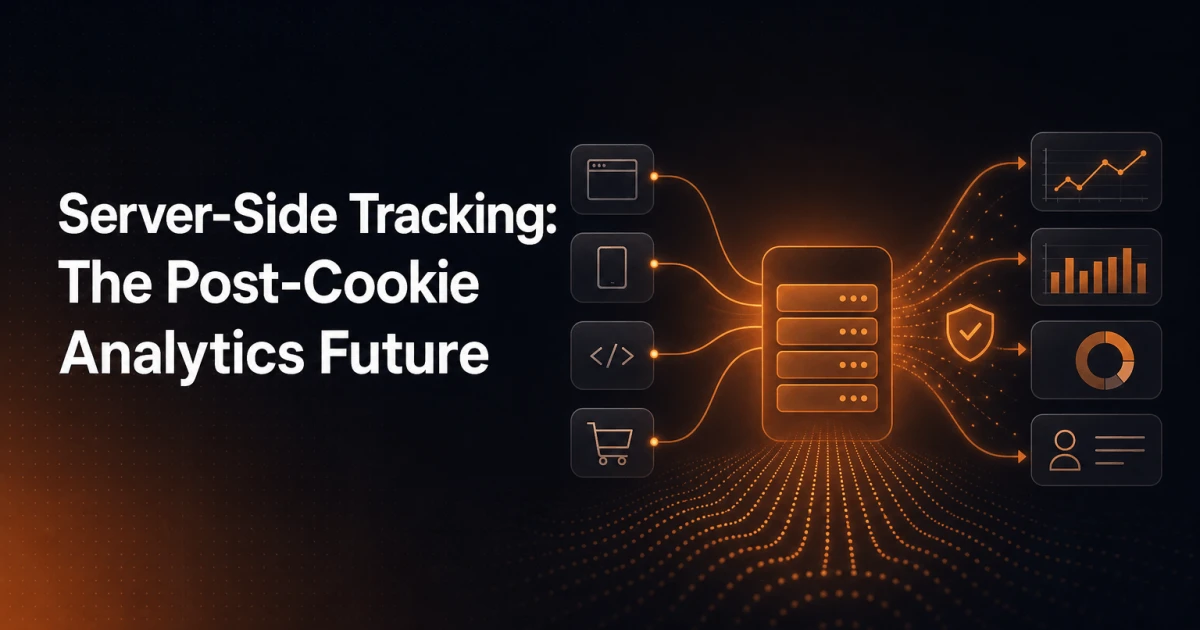
Server-side tracking moves tag execution off the user's browser and onto a server you control. Instead of loading Google Analytics, the Meta Pixel, LinkedIn Insight Tag, and a dozen other scripts directly into the browser - where they can be blocked, throttled, or rejected - your site sends a single event to your own server endpoint. That server then forwards the data to whichever platforms need it.
The browser is no longer the execution environment for your tracking. Your server is.
This is not a workaround for consent law. Users who decline analytics consent should not be tracked - and a correctly implemented server-side setup respects that boundary exactly as a client-side one should. What server-side tracking does recover is the signal lost to ad blockers and browser-level restrictions for users who have consented but whose data was being dropped anyway.
How the Infrastructure Works
The most common implementation pattern uses a server-side tag manager - Google's Server-Side Tag Manager (SSCM) or third-party managed solutions like Stape.io - deployed on a subdomain of your own domain.
The flow looks like this:
A user interacts with your site. A lightweight client-side script (often a modified GTM web container) captures the event and sends it to your tagging server - for example,
data.yourdomain.com.Your tagging server receives the event. Because the request goes to your own subdomain, it bypasses most ad blockers that maintain blocklists of known third-party tracking domains.
The server processes the event and forwards it to your downstream platforms: Google Analytics 4 via the Measurement Protocol, Meta via the Conversions API (CAPI), Google Ads via Enhanced Conversions, and so on.
First-party cookies set by the server - via HTTP response headers rather than JavaScript - are not subject to ITP's client-side cookie caps. On Safari, a server-set cookie can persist for the full duration you configure, rather than being capped at seven days.
The key technical detail: the cookies are set server-side, the requests originate from your infrastructure, and the data forwarding happens server-to-server rather than browser-to-third-party. Ad blockers operate primarily by blocking known tracking domains in browser network requests. They cannot block server-to-server communication that happens after the initial event is received.
Google SSCM vs. Stape.io
Google's own Server-Side Tag Manager is free to use but requires hosting - typically on Google Cloud Run or App Engine, which adds infrastructure cost and maintenance overhead. Stape.io is a managed hosting layer built specifically for SSCM, reducing the operational complexity considerably. For teams without dedicated DevOps capacity, managed solutions lower the barrier to entry significantly. The tag templates and data layer logic are largely the same either way.
What You Actually Recover
The benefits are real but bounded. Here is what server-side tracking genuinely improves:
Conversion tracking accuracy for consented users: Events that were previously blocked by ad blockers now reach your analytics and ad platforms. For e-commerce sites, this directly improves ROAS measurement accuracy and allows ad platform algorithms to optimise on a more complete signal. Meta's own data suggests that CAPI implementations recover 15-30% of conversion events lost to browser-side pixel blocking.
Longer-lived first-party cookies: Server-set cookies bypass ITP's JavaScript cookie caps. A returning customer on Safari who visits after eight days is no longer misidentified as a new user. Session stitching and attribution windows become reliable again.
Reduced page weight and load time: Instead of loading ten separate tracking scripts in the browser - each with its own network request, execution overhead, and potential render-blocking behaviour - you load one lightweight endpoint call. This has a measurable impact on Core Web Vitals, particularly Total Blocking Time and Time to Interactive.
Centralised data control: Your server becomes the canonical source of event data before it fans out to platforms. You can enrich, filter, redact, or transform data at the server layer rather than trusting each vendor's client-side script to behave correctly.
What You Cannot Recover - And Why That's Correct
Server-side tracking does not and should not circumvent consent. A user who declines analytics cookies is not tracked - and no implementation should attempt to work around that. The right architecture fires server-side events only for users who have provided valid consent, propagating the consent signal from your CMP through to the tagging server before any event is forwarded.
Users browsing anonymously, using Tor, or operating in strict privacy modes represent a real portion of your audience that will remain invisible to analytics. That is not a data quality problem to solve. It is the correct outcome of a privacy-respecting web.
The goal of server-side tracking is not to track everyone - it is to stop losing data for the users who have explicitly agreed to be measured.
WordPress Implementation: What's Actually Involved
On WordPress specifically, implementing server-side tracking involves more moving parts than flipping a plugin toggle. The practical steps:
Deploy a tagging server: Set up Google SSCM on a cloud provider or use a managed service like Stape.io. Configure a subdomain (e.g.,
metrics.yourdomain.com) pointing to the server. This requires DNS configuration - a CNAME record pointing to your tagging server's endpoint.Modify your client-side GTM container: Update your web GTM container to send events to your tagging server endpoint rather than directly to Google's servers. The GA4 configuration tag needs its transport URL updated.
Integrate your CMP: Your consent management platform must pass consent state to the data layer before any tracking fires. This is non-negotiable. Most major CMPs have GTM integrations, but they need explicit configuration to block tags until consent is granted.
Configure server-side tags: Inside your SSCM container, set up client templates to receive incoming events and vendor tags to forward them - GA4, Meta CAPI, Google Ads Enhanced Conversions, and so on.
Test thoroughly: Use GTM's preview mode, your browser's network tab, and the Meta Events Manager's test events feature to verify that events are firing correctly, consent gating is working, and no data is leaking to platforms for non-consented users.
WordPress itself doesn't add meaningful complexity to the server-side layer - your tagging server runs independently of WordPress. The complexity lives in the GTM configuration, the CMP integration, and the server infrastructure. If you're already running a technically mature WordPress setup and want to audit what your current tracking is missing, the Signocore SEO Analyzer can surface performance and technical issues that compound tracking problems - particularly around page speed factors that affect tag firing reliability.
When Server-Side Tracking Is Worth the Investment
Server-side tracking is not the right answer for every site. The infrastructure and configuration overhead is real, and for low-traffic or low-conversion-volume sites, the accuracy gains may not justify the cost.
The investment makes clear sense when:
Your site targets a technical or privacy-conscious audience where ad blocker adoption is high. If you're building developer tools, security products, or anything that attracts power users, your client-side tracking data is probably missing a third to half of your events.
You're running paid media campaigns where conversion data feeds algorithmic bidding. Missing 25% of conversions doesn't just make your reporting inaccurate - it actively degrades the performance of Smart Bidding and Meta's Advantage+ by starving the algorithm of signal.
Safari is a significant share of your traffic. If more than 20% of your sessions come from Safari - standard for most consumer-facing sites - ITP is actively corrupting your attribution and return-visitor data.
You need defensible, audit-ready data. A server-side architecture with proper consent gating and server-to-server forwarding produces a more auditable data trail than a spray of client-side scripts.
Client-side tracking remains sufficient when your audience has low ad blocker adoption, your conversion volumes are too low to feed meaningful algorithmic optimisation, or the operational overhead of maintaining server infrastructure exceeds the value of the recovered signal. A small content site with display ads and no paid acquisition doesn't need SSCM.
The Measurement Gap Is Not Going to Close Itself
The browser privacy improvements that are breaking your tracking are not bugs - they are deliberate, correct, and permanent. ITP is not going away. Consent requirements are expanding, not contracting. Ad blocker adoption is not declining. The measurement gap between what you're currently capturing and what is actually happening on your site will continue to widen if your infrastructure stays static.
Server-side tracking is not a silver bullet, and it is not a way to ignore privacy law. It is a technically sound architecture that recovers legitimate signal for consented users, reduces your dependence on third-party scripts executing in the browser, and gives you actual control over your own data pipeline. For teams running paid acquisition at any meaningful scale, or serving audiences with high privacy tool adoption, the cost of not implementing it is already being paid - in degraded attribution, misallocated budget, and decisions made on incomplete data.
The gap between your analytics and reality is larger than you think. The question is whether you're going to measure it accurately or keep optimising for a number that was never real.