Most SEO investment chases the same two activities: content production and backlink acquisition. Both are expensive. Both take months to show results. Internal linking, by contrast, costs almost nothing, can be implemented this week, and directly influences how search engines crawl, understand, and rank every page on your site. The return on investment is disproportionately high - yet the majority of WordPress sites treat internal linking as an afterthought, if they think about it at all.
The reason is partly invisible: unlike a broken backlink or a missing meta description, a weak internal link structure rarely triggers an error. It just silently limits your rankings. Fixing it is one of the few SEO interventions that improves both crawlability and semantic relevance at the same time.
Why Internal Links Carry More Weight Than Most Teams Realize
Internal links do three distinct jobs simultaneously. First, they pass PageRank - the link equity that Google uses as a proxy for authority. A page that receives no internal links is essentially invisible to Googlebot regardless of how good its content is. Second, they establish topical relationships between pages, helping search engines build a model of what your site is actually about. Third, they guide users deeper into your content, increasing dwell time and reducing the probability of a pogo-stick back to the search results page.
Backlinks from external sites accomplish only the first of those three jobs. Internal links accomplish all three, and you control them entirely. That asymmetry is what makes a deliberate internal linking strategy one of the most efficient moves available to an SEO team working with finite resources.
The Hub-and-Spoke Model: Pillars and Clusters
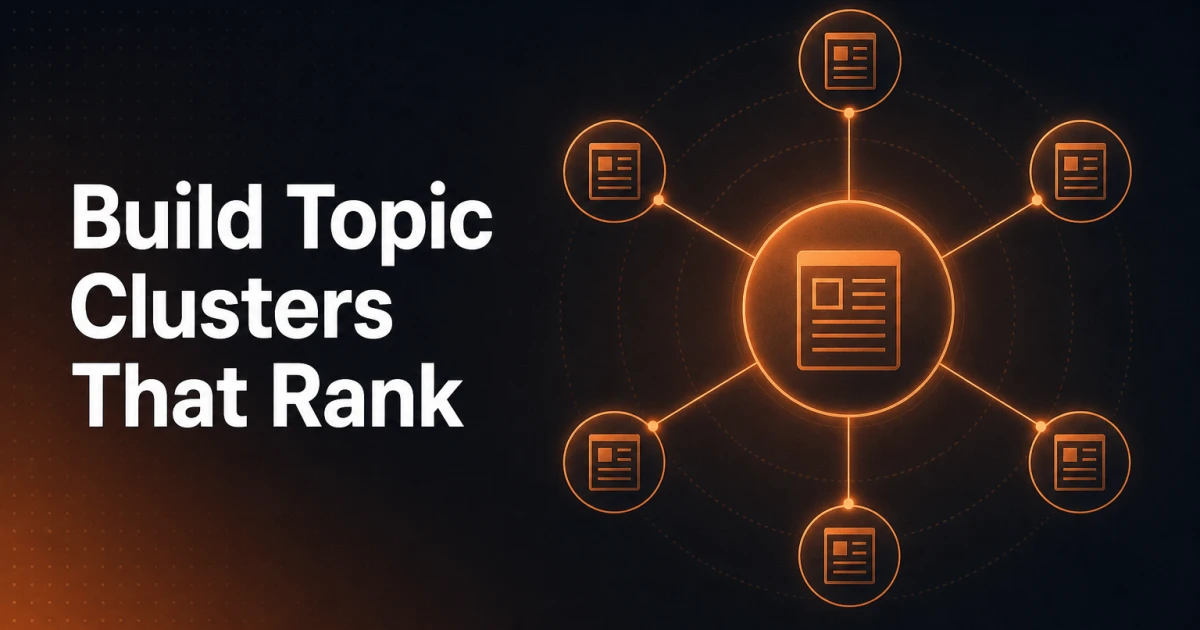
The most effective framework for organizing internal links at scale is the hub-and-spoke model, commonly called the pillar-cluster or topic cluster approach. The concept is straightforward: one authoritative pillar page covers a broad topic comprehensively, and a set of cluster pages each explore a specific subtopic in depth. Every cluster page links back to the pillar, and the pillar links out to every cluster page.
The result is a tightly connected web of content that signals topical authority to search engines. Google's systems can observe that your pillar page on, say, technical SEO is connected to clusters on structured data, Core Web Vitals, crawl budget, and hreflang - and conclude that your site has genuine depth on the subject. That topical authority is increasingly what separates sites that rank across an entire subject area from those that rank for isolated keywords.
A Worked Example: A Topic Cluster on Technical SEO
Consider a site building authority in technical SEO. The cluster might look like this:
Pillar page: "The Complete Guide to Technical SEO" - covers the full landscape of technical optimization, links out to every cluster page, and targets high-volume head terms.
Cluster page 1: Structured data and schema markup - explores how structured data supports modern SEO, links back to the pillar and to adjacent clusters on crawlability and rich results.
Cluster page 2: Core Web Vitals - deep-dives into LCP, CLS, and INP, references the pillar, and cross-links to the structured data cluster where performance and schema intersect.
Cluster page 3: Hreflang and international SEO - covers multilingual implementation, links back to the pillar, and references the Core Web Vitals cluster where mobile performance overlaps.
Cluster page 4: Crawl budget optimization - covers robots.txt, sitemaps, and internal link architecture, which naturally closes the loop back to the pillar.
Each page in this cluster reinforces the others. When one cluster page earns a backlink, some of that equity flows through the internal link network to the pillar and sibling pages. The architecture multiplies the value of every external link the site earns.
Auditing Your Current Internal Link Structure
Before building new clusters, understand what you already have. A link audit answers four questions: Which pages receive no internal links at all (orphan pages)? Which pages are over-linked to the point of diluting their signal? Are anchor texts descriptive and varied, or generic and repetitive? Does the link structure reflect your intended topic clusters, or is it random?
A crawl tool like Screaming Frog or a log file analyzer will expose orphan pages and link depth quickly. Export the data into a spreadsheet, map each URL to its intended cluster, and identify gaps. The Signocore SEO Analyzer surfaces link-related issues as part of its on-page audit, giving you a fast read on pages that are poorly connected before you start a full crawl.
Pay particular attention to pages that rank on page two or three for their target keyword. These are often pages with good content but insufficient internal link equity - they are close to ranking, and a handful of well-placed internal links can push them over the threshold.
Anchor Text: The Rules That Actually Matter
Anchor text is the semantic signal that tells search engines what the linked page is about. Generic anchors like "click here" or "read more" waste that signal entirely. Exact-match anchors used repetitively across dozens of pages look manipulative. The approach that works is descriptive, varied, and contextual.
Descriptive means the anchor text accurately reflects the content of the destination page. If you are linking to a cluster page on Core Web Vitals, anchors like "page experience signals," "LCP and CLS optimization," or "Core Web Vitals performance" all communicate the topic clearly.
Varied means you use different phrasings across different source pages. Natural writing produces natural variation. If every internal link to your pillar page uses the exact same three-word phrase, it reads as engineered.
Contextual means the anchor appears within a sentence that provides surrounding context. A link embedded in a relevant paragraph passes more semantic value than a link in a sidebar widget or a generic "related posts" block.
How Many Internal Links Per Post
There is no universal rule, and anyone offering a precise number is guessing. The practical answer is: enough to be genuinely useful, not so many that the page becomes a link directory. For a typical 1,500-2,000 word cluster page, three to seven internal links is a reasonable range. A pillar page covering a broad topic comprehensively might carry fifteen to twenty links to its cluster pages - that is appropriate because the pillar's explicit purpose is to serve as a navigation hub.
The quality test is simple: if you removed the link and replaced it with plain text, would the reader lose something useful? If yes, the link earns its place. If the link is there purely to pass equity with no navigational value, it is noise.
Common Mistakes That Undermine Topic Clusters
Orphan pages are the most damaging structural failure. A page with no internal links pointing to it cannot be discovered through normal crawling, cannot accumulate link equity from your other pages, and signals to search engines that the content is peripheral to your site's purpose. Every published page should receive at least one contextual internal link from a related piece of content.
Over-linking from a single page dilutes the PageRank passed to any individual destination. When a 500-word post contains twenty internal links, each link carries a fraction of the equity it would carry if the page contained five. Prioritize the links that matter most - particularly those pointing to pages you want to rank.
Inconsistent anchor text across a cluster confuses the topical signal. If your pillar page on SEO is referenced as "search engine optimization" in some posts and "SEO strategy" in others, that inconsistency is fine - it is natural variation. But if some pages link to it with completely unrelated anchors because an editor grabbed the nearest phrase, you are undermining the semantic coherence of the cluster.
Flat site architecture - where every page is linked from the homepage and nowhere else - concentrates equity at the top and starves deeper content of authority. Topic clusters solve this by creating a middle tier of pillar pages that redistribute equity across the cluster.
Implementing Topic Clusters in WordPress
WordPress does not provide native tools for managing topic clusters, which means implementation usually relies on editorial discipline, a content map, and whatever plugin support you can add. A few practical approaches make this more manageable at scale.
Maintain a content map - a spreadsheet or database that records every published URL, its assigned cluster, its pillar page, and the status of its required internal links. This is unglamorous work, but it is the only way to ensure that new content gets properly connected and that existing gaps are tracked rather than forgotten.
When you publish a new cluster page, immediately add a contextual link to it from the pillar and from at least one sibling cluster page. Then update the pillar to link back to the new page. This three-way connection ensures the new page enters the link graph immediately rather than sitting as a temporary orphan.
For WordPress sites managing large content libraries, the Signocore Glossary plugin adds a structural layer that directly supports internal linking strategy. It creates a dedicated glossary of terms - each term gets its own URL and definition page - and automatically links those terms wherever they appear in your content. For sites covering technical subjects, this means every mention of a defined concept becomes an internal link without manual intervention. The glossary pages themselves become a cluster of their own, pointing back to the deeper content that covers each concept in full. It is an architectural decision that compounds over time: the more content you publish, the more the glossary network grows and the more internal link equity flows through the site.
The Signocore SEO plugin complements this by handling the technical layer - schema markup, canonical tags, and structured metadata - so your topic clusters are not only well-linked but also correctly interpreted by search engines at the structured data level.
Connecting Internal Linking to Broader Semantic SEO
Topic clusters are the practical expression of semantic SEO. Where keyword optimization asks "what term does this page target," semantic SEO asks "what subject does this site own." Internal linking is the mechanism that communicates the answer to that second question. A site where every page exists in isolation, linked only from the homepage and a navigation menu, cannot demonstrate topical depth no matter how good the individual content is.
The relationship between internal linking and AI-driven search features like Google's AI Overviews is also worth noting. These systems synthesize answers from sources they consider authoritative on a topic. A tightly clustered site that clearly signals topical ownership is better positioned to be treated as an authoritative source than a site with the same content but no structural coherence.
Internal linking is not a one-time project. It is an ongoing editorial practice - the discipline of treating every new piece of content as a node in a network rather than a standalone document. Sites that build this habit into their publishing workflow accumulate a structural advantage that is genuinely difficult for competitors to replicate quickly, because it is built post by post, link by link, over time.