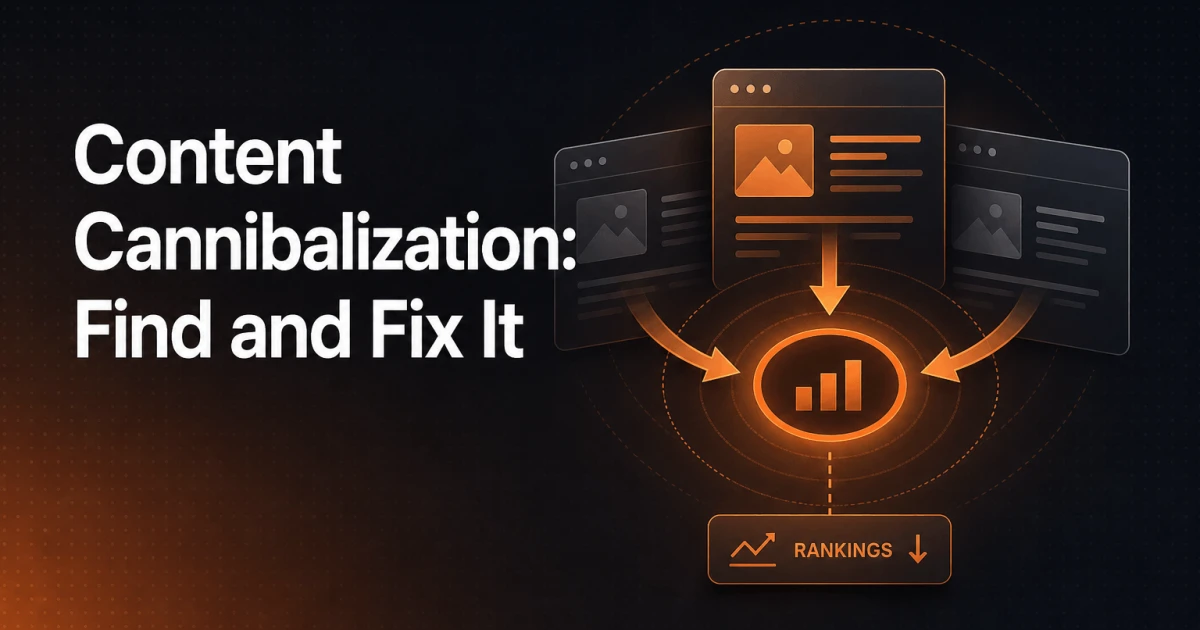
When two pages on your site compete for the same keyword, neither wins convincingly. Google is forced to pick one, often inconsistently, and both pages end up underperforming compared to what a single authoritative page would achieve. That is content cannibalization - and it is one of the more insidious SEO problems because it develops gradually, quietly, and almost always as a side effect of doing the right thing: publishing content.
What Content Cannibalization Actually Means
Content cannibalization occurs when multiple pages on the same domain target the same keyword or satisfy the same search intent. The result is that Google's ranking algorithm must arbitrate between them, often ranking the wrong page, switching between them across updates, or diluting the authority that would otherwise consolidate behind a single URL.
The keyword overlap is only part of the problem. Intent overlap is the deeper issue. Two pages can target slightly different keyword phrasings but serve the same searcher need - and Google treats them as competitors regardless of whether the exact terms match. A page titled "Best WordPress SEO plugins" and another titled "Top SEO plugins for WordPress" are cannibalizing each other even if neither contains the other's exact title phrase.
Why It Happens
Cannibalization is rarely intentional. It emerges from a few predictable patterns as sites grow.
No keyword mapping: Without a document that assigns specific keywords and intents to specific URLs, writers naturally gravitate toward the same high-value topics. Three different contributors might each write a "beginner's guide to technical SEO" over three years, with no one noticing the overlap until rankings stagnate.
Category pages versus blog posts: This is one of the most common structural culprits in WordPress sites. A category archive page for "On-Page SEO" and a cornerstone blog post called "The Complete Guide to On-Page SEO" will often target identical queries. Category pages are generated automatically and rarely optimized with intent, yet Google indexes and ranks them alongside editorial content.
Uncontrolled site growth: As content volume scales, especially across agencies managing multiple contributors or clients publishing at high frequency, topic overlap compounds. What starts as two slightly different angles on a subject evolves into four or five pages all chasing the same SERP position.
Faceted navigation and tags: E-commerce sites and content-heavy WordPress installs often generate dozens of thin, auto-generated pages through tag archives, filter combinations, or pagination - all of which can surface for the same queries as their parent pages.
How to Find It
Detection requires looking at your site from Google's perspective, not your own content calendar.
Google Search Console
Search Console is the most direct signal available. Navigate to the Performance report, filter by a specific query you want to investigate, and then switch the breakdown to "Pages." If more than one URL is receiving impressions for that query, you have a cannibalization candidate. Pay attention to click-through rate drops on what should be your primary page - a declining CTR on a high-impression query often means Google is oscillating between URLs.
Export your top queries and cross-reference them against page URLs systematically. Any query where two or more pages appear in the same data slice deserves investigation.
Site: Search Operator
A quick diagnostic is to run site:yourdomain.com "keyword phrase" in Google. If multiple pages appear in the results, Google has indexed and associated all of them with that phrase. This is a blunt instrument but useful for a fast initial scan on specific topics you suspect are duplicated.
Ahrefs and Semrush
Paid tools make systematic detection significantly faster. In Ahrefs, the "Organic Keywords" report at the site level can be filtered to show keywords where multiple pages rank in the top 20. Semrush's Position Tracking tool includes a cannibalization report that surfaces this automatically. Both approaches let you sort by keyword volume to prioritize which overlaps are worth addressing first.
Running a full SEO Analyzer audit on your key pages can also surface structural signals - duplicate title tags, overlapping meta descriptions, and thin content patterns that correlate with cannibalization risk.
The Four Fix Options
Not every instance of cannibalization calls for the same solution. The right fix depends on the relationship between the competing pages, the quality of each, and whether their content can be salvaged independently.
Merge and 301 Redirect
When to use it: The two pages cover the same topic with significant content overlap, one page is clearly stronger in terms of depth, backlinks, or engagement, and the weaker page does not serve a distinct audience segment or intent.
This is the most common and most effective fix. Combine the best content from both pages into a single, more comprehensive URL. Redirect the weaker URL to the stronger one with a permanent 301 redirect. Backlinks, internal links, and ranking signals consolidate onto the surviving page, and Google no longer has to choose between them.
Before merging, check whether the weaker page has any unique inbound links or ranks for secondary keywords that the stronger page does not. If so, ensure that content is incorporated into the merged version before the redirect goes live.
Differentiate Intent
When to use it: The two pages target overlapping keywords but could legitimately serve different searcher intents - one informational and one transactional, for example, or one targeting beginners and one targeting advanced practitioners. Both pages have enough unique value to stand independently if properly repositioned.
Rewrite one page to serve a clearly distinct angle. Update its title, meta description, headings, and body content to reflect a different stage of the funnel or a different sub-topic. The goal is to ensure that a reader landing on either page would immediately understand why this page - and not the other one - answers their specific question. Internal linking between the two pages, with anchor text that signals their distinction, reinforces the differentiation for both users and crawlers.
Consolidate with a Canonical Tag
When to use it: You need both URLs to remain accessible - for technical reasons, legacy linking structures, or because they serve different UX contexts - but you want Google to attribute ranking signals to a single preferred version. Use this as a last resort, not a default fix.
A rel="canonical" tag on the weaker page pointing to the preferred URL tells Google which version to consolidate signals around. This is appropriate for near-duplicate content that cannot be merged or redirected - faceted navigation pages, printer-friendly versions, or paginated sequences. It is not a substitute for a merge when a merge is technically feasible. Canonicals are hints, not directives, and Google does not always honor them when it judges the pages to be meaningfully different.
Noindex the Weaker Page
When to use it: The weaker page has no meaningful content value, no inbound links worth preserving, and no audience that specifically needs it - but it still needs to exist at that URL for functional reasons (such as a tag archive or a filter page in a WordPress theme).
Adding noindex via a meta robots tag or via your SEO plugin removes the page from Google's index without breaking the URL. This is particularly useful for automatically generated archive pages in WordPress - tag pages, author archives, date archives - that duplicate content from posts and categories. Noindexing these is often part of a broader technical cleanup rather than a targeted cannibalization fix.
Preventing Cannibalization Going Forward
Detection and repair is a reactive process. Prevention requires building intent tracking into how content is planned before it is written.
Keyword mapping: Maintain a living document - a spreadsheet, a Notion database, whatever your team will actually use - that maps each target keyword and its primary intent to a single canonical URL. Before any new piece is commissioned, check whether the target keyword already has a mapped page. If it does, the decision is either to update that page or to define a sufficiently distinct angle that justifies a new URL.
Content calendar with intent tracking: A content calendar that logs only titles and publication dates is insufficient. Each entry should include the primary keyword, the intent category (informational, navigational, transactional, commercial investigation), and the target URL. This makes overlaps visible at the planning stage rather than after publication.
Regular audits tied to Search Console data: Cannibalization is not a one-time problem to solve and forget. As sites grow, new overlaps emerge. A quarterly review of Search Console performance data - specifically looking for queries where impression share is split across multiple URLs - catches new cannibalization before it compounds. This review naturally feeds into the broader content audit process.
Cannibalization Within the Content Audit Process
Content cannibalization detection is a subset of a full content audit, not a standalone exercise. A complete audit evaluates every page for traffic contribution, quality, uniqueness, and strategic fit. Pages that cannibalize are often also pages that are thin, outdated, or misaligned with current search intent - meaning the fix for cannibalization frequently overlaps with fixes for content decay and topical authority gaps.
When conducting a content audit, group pages by topic cluster before evaluating individual URLs. This makes cannibalization patterns immediately visible: if a cluster has six pages and three of them rank for variants of the same query, the cluster structure itself needs to be redesigned, not just individual pages patched. The goal is to have each cluster anchored by one strong pillar page, supported by genuinely distinct sub-topic pages that link back to it - a structure that distributes authority rather than fragmenting it.
For teams working within WordPress, keeping content architecture clean from the start is significantly easier than untangling it later. Structured content planning, disciplined use of categories and tags, and periodic audits using tools like the SEO Analyzer to catch on-page signals that indicate overlap all reduce the remediation burden over time. The articles on how structured data supports modern SEO and Core Web Vitals address complementary dimensions of the same underlying discipline: maintaining a site where every page earns its place in the index.
Content cannibalization is a structural problem with structural solutions. Identifying which fix applies requires honest assessment of each page's value, its relationship to competing pages, and whether the content can be consolidated without losing anything genuinely useful to readers. Applied consistently - and prevented through disciplined planning - the result is a leaner site where ranking signals concentrate rather than scatter.