Search engines like Google rely on web crawlers to discover, crawl, and index your web pages. But did you know that search engines have limited resources for this process? This is where crawl efficiency plays a crucial role. By optimizing how search engines navigate your site, you can ensure they focus on the most important pages.
One of the most effective ways to improve crawl efficiency is by using log file analysis. These files provide SEO experts with insights into how search engines interact with their pages. In this post, we'll look at why crawl efficiency is critical, how log file analysis can help, and practical techniques for optimizing your page's crawl budget and internal links. Additionally, we introduce the WordPress plugin Signocore SEO, a powerful tool designed to optimize crawl efficiency on your website.
Why is crawl efficiency important?
Crawl efficiency refers to how well a search engine can crawl and index the most important pages on your website. If crawlers waste time on unnecessary pages (such as duplicate content or low-value pages), they may miss critical pages that drive traffic and conversions.
If your site is large or has many URLs, search engines may not have the time or resources to crawl every single page. This is where the concept of crawl budget comes into play – the number of URLs a search engine will crawl within a given timeframe. By ensuring your crawl budget is used optimally, you can substantially impact your page's SEO performance.
Common crawl efficiency problems
Duplicate content: Search engines waste resources crawling identical content multiple times.
Orphan pages: Important pages without internal links can be overlooked by crawlers.
Slow loading times: Pages that take too long to load can prevent more of your pages from being crawled.
Unnecessary pages: Pages such as tag archives or paginated comments can have low SEO value but are still crawled.
How log file analysis helps
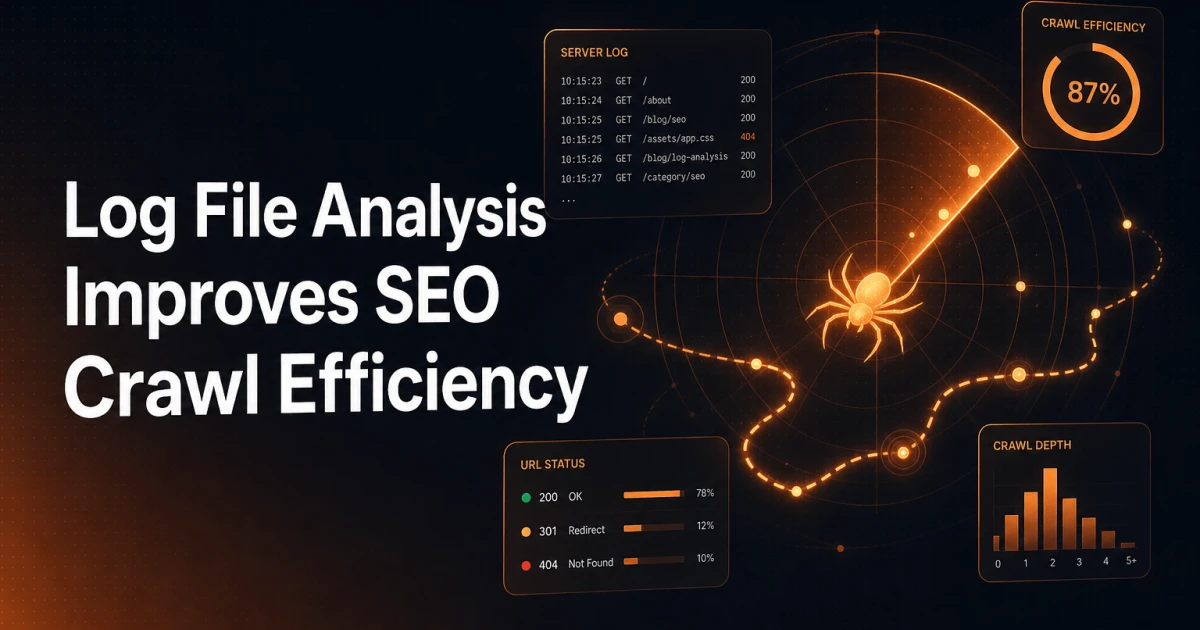
Log files are a record of all activity between your web server and search engine crawlers. By analyzing these files, you can gain insight into which pages are crawled, how often, and how effectively.
Key benefits of log file analysis
Identify crawl problems: Log files show exactly how search engines interact with your site. This data helps reveal whether important pages are being crawled or if the crawl budget is wasted on low-priority pages.
Find crawl errors: If crawlers encounter 404 errors or other server issues, these will be logged. Fixing these errors ensures a smooth crawl and indexing process.
Track crawler behavior: You can analyze which paths crawlers take through your site and see which sections get the most attention and which are ignored.
Using log file data, SEO specialists can take concrete steps to optimize how search engines crawl their websites.
Techniques to optimize crawl budgets
Optimizing your crawl budget is about ensuring search engines focus their resources on your most important pages. Here are some proven techniques:
1. Prioritize important pages
Not all pages are equally important. Focus your crawl budget on pages with the greatest SEO value, such as those targeting important keywords, generating traffic, or creating leads. Use tools like robots.txt to restrict crawling of low-value or duplicate pages.
2. Improve your site's speed
Search engines prefer to crawl pages that load quickly. By optimizing load times, you not only improve the user experience but also increase the likelihood that crawlers can reach more of your site within the allocated time. Use compression, image optimization, and caching to improve speed.
3. Optimize internal links
Strong internal link structures guide search engine crawlers to the most important pages. Ensure there are clear paths from your homepage and your most authoritative pages to key content. Fix orphan pages by adding links to them from relevant content.
4. Use structured data
Structured data helps search engines understand your content better, making it easier for them to decide what should be crawled and indexed. Implement schema markup on key pages so crawlers can quickly identify their relevance.
Introduction to Signocore SEO: A WordPress plugin for crawl efficiency
For WordPress site owners, technical SEO can be overwhelming. This is where Signocore SEO comes into play. This plugin is designed to handle essential SEO tasks that directly affect crawl efficiency, including:
Implementation of structured data: Automatically adds schema markup to your content, helping search engines better understand and crawl your site.
Social meta tags: Ensures that search engines and social media platforms have all the necessary information to correctly display your content.
Memory log for troubleshooting: Signocore SEO has an integrated memory log that identifies potential memory leaks, ensuring your site runs optimally during crawling.
Comprehensive object cache mechanism: Signocore SEO leverages advanced object caching, ensuring that all plugin data and metadata are processed as efficiently as possible. Unlike traditional page caching, where whole pages are stored for faster delivery, object caching stores smaller data chunks, such as database queries, to reduce the load on your server. This improves back-end performance and results in faster load times. Since search engines prefer fast websites, Signocore SEO's object cache optimizes your crawl budget by ensuring crawlers can navigate your site more efficiently and give more attention to the most important pages.
By using Signocore SEO, you can ensure that your WordPress site is not only optimized for search engine crawlers but also runs smoothly and efficiently, giving you the best chances of ranking well in search results.
Final thoughts
Crawl efficiency is a key component of successful SEO, especially for larger websites. By analyzing log files, you can gain valuable insights into how search engines interact with your site, and you can make informed decisions about where to direct their attention. When you combine this with techniques to optimize the crawl budget—such as improving internal links and using structured data—you ensure that your most important pages are indexed.
For WordPress users, Signocore SEO is an invaluable tool for improving crawl efficiency. With its user-friendly features and advanced object caching, you can effectively manage your site's SEO and ensure search engines have everything they need to crawl and index your content quickly.
Discover how Signocore SEO can improve your site's crawl efficiency.